
Lehua Island after the rats
In November 2016 I found a dead black rat in the grass on Lord Howe Island. I photographed it and uploaded it to iNaturalist, the way I do with almost everything I see. I didn’t think of it as a conservation record at the time. In hindsight, it was one.
Lord Howe was still fighting its rats with poison bait around the settlement then, a holding action the island had kept up for decades. Rats killed that way are replaced within a season. The island’s residents were in the middle of a long and sometimes bitter argument over whether to try something far more ambitious: removing every rat and mouse from an island where 350 people live. Two and a half years later, they did.

Lord Howe kept reminding me of another island. In 2011 I dived just off Lehua, the crescent-shaped remnant of a volcanic crater off Niʻihau, Hawaiʻi. Lehua had a rat problem of its own, and it had just lost a round: a 2009 attempt to remove its Polynesian rats had failed. Both islands eventually succeeded, by quite different routes, and the differences are where the real lessons are.
Lehua
Lehua is small, about 115 hectares, and no one lives there. It is a state seabird sanctuary with at least 17 seabird species, one of the largest and most diverse colonies in the main Hawaiian Islands. It was also home to Polynesian rats, which take eggs, chicks, and sometimes adults on the nest. The damage showed in what was missing: small burrow-nesters, and open-ground nesters such as terns and noddies, were scarce or absent.
Restoration came in stages. Rabbits went first, in 2006, and native plants began to recover. The 2009 rat attempt failed in part because bait went down in strong winds and a shoreline buffer was left untreated; rats in that zone survived and repopulated the island. The second attempt, in August and September 2017, used three helicopter applications of diphacinone bait in calm weather and covered the whole island. Even so, cameras picked up a few survivors in the following months, and crews spent more than two years trapping and spot-baiting before the state declared Lehua rat-free in April 2021.
Bulwer’s petrels, small enough to be easy prey, were among the first birds to respond. The partners now hope the endangered Newell’s shearwater, which has tried to nest on Lehua without success, will finally establish there.

Lord Howe
Lord Howe is a harder problem. At about 1,455 hectares it is roughly thirteen times the size of Lehua, it rises to forested mountains, and it has a permanent community. House mice had arrived by 1860. Ship rats came ashore in 1918, when the steamer SS Makambo ran aground, and the effect was swift. Five endemic land birds disappeared.
The Lord Howe Island stick insect, once common enough to be used as fishing bait, was not seen after 1920 and was presumed extinct until climbers found a tiny population on Ball’s Pyramid, a sea stack 23 km offshore, in 2001. By the time I visited, descendants of those survivors were being bred in captivity, and the island’s museum had live ones on display. One of the staff let an insect walk along her arm so I could photograph it.

The 2019 eradication had to work around people as much as terrain. Helicopters baited the mountains, but in the settlement crews laid out about 19,000 bait stations on a 10 m grid, plus another 4,300 inside houses and other buildings. The bait was brodifacoum, a second-generation anticoagulant that is far more potent and persistent than Lehua’s diphacinone. That choice had a cost. The island’s flightless woodhen and its endemic currawong were likely to eat bait or poisoned rodents, so keepers from Taronga Zoo took 220 woodhens and 129 currawongs into temporary captivity and held them until the bait had broken down.

Lehua had no native land birds at comparable risk, so its concern was the ocean instead. After each drop, federal scientists sampled seawater, crabs, ‘opihi, and fish. Three of twelve crabs carried detectable residues immediately afterward; none did two weeks later.
Lord Howe had its setback too. In April 2021, almost two years after baiting, rats turned up in the settlement. About a hundred were caught, and genetic work indicated they descended from a small group that had survived 2019, not from a new arrival. The island was finally declared rodent-free in 2023.
The response matched Lehua’s. Black-winged petrel breeding success rose from as low as 2.5% to 67% within a year, woodhen numbers roughly tripled within 18 months, and masked boobies now breed on the main island.
| Lehua | Lord Howe | |
|---|---|---|
| Area | ~115 ha | ~1,455 ha |
| Residents | None | ~350 |
| Rodents | Polynesian rat | Ship rat, house mouse |
| Toxicant | Diphacinone (aerial) | Brodifacoum (aerial and bait stations) |
| Non-target safeguard | Marine residue monitoring | Captive holding of woodhens and currawongs |
| Setback | Failed attempt (2009); survivors after 2017 | Survivors detected 2021 |
| Declared free | 2021 | 2023 |
What the two have in common
Neither eradication worked cleanly the first time. Lehua needed a second attempt and two years of follow-up; Lord Howe needed an emergency response to survivors no one knew were there. That is why both programs, like most island eradications, waited through two years without a detection before calling it done. Both also built on earlier, smaller wins: rabbits on Lehua; feral cats, pigs, goats, and invasive ants on Lord Howe.
The larger lesson is that the biology was the easier part. Lehua’s partners had to answer fishermen’s concerns about rodenticide in the water they fish. Lord Howe’s residents argued for years about putting poison in and around their own homes, and the project could not go ahead until enough of them agreed. Neither island can stop now, either. Lord Howe’s 2025 final report concludes that staying rodent-free is harder than the eradication itself, which is why dogs now search incoming boats.
The view from underwater
There is one more reason a diver should care. Seabirds carry nutrients from the open ocean to their colonies, and their guano washes back into the surrounding water. In the Chagos Archipelago, Graham and colleagues found that reefs next to rat-free islands with dense seabird colonies supported more fish biomass, and faster-growing fish, than reefs next to nearby islands with rats.
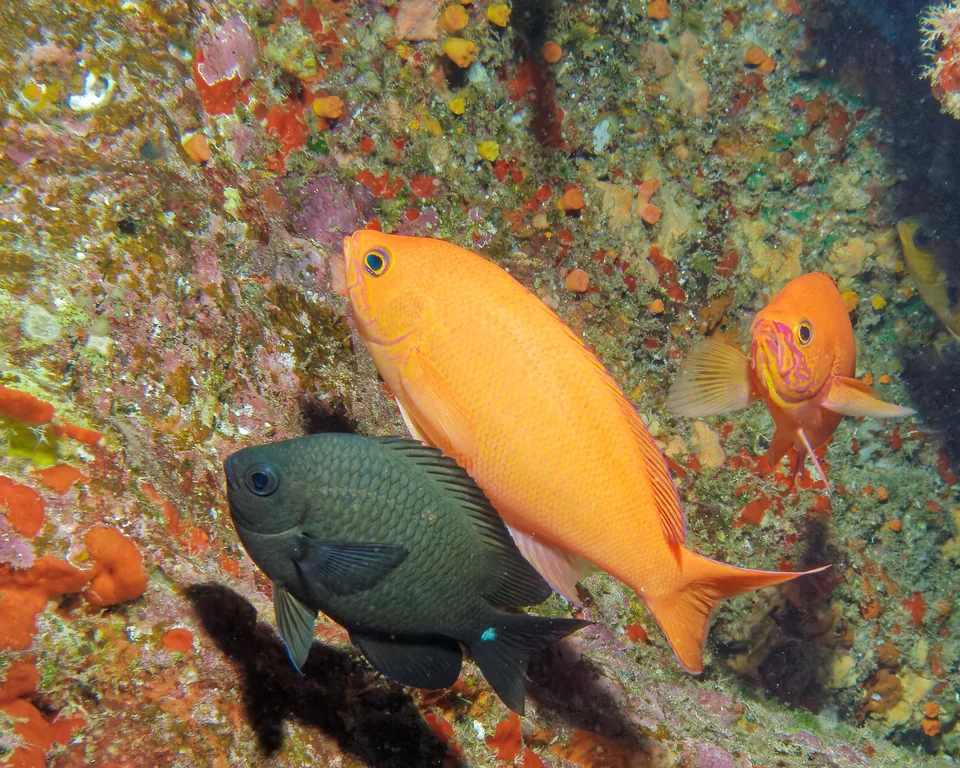
Whether Lehua’s reefs or Lord Howe’s lagoon, the southernmost coral reef in the world, will show the same effect is an open question. Lehua’s partners planned marine surveys against their pre-eradication baseline to find out. My own dives off Lehua in 2011, and that rat on Lord Howe in 2016, both come from before the rats were gone. I didn’t make them as baseline data, but that is what they have become. If you dive or walk either island now, your records are the other half of the comparison. (Here is why that matters.)
Sources
- Hawaiʻi DLNR (2021). Success! Lehua Island is rat free.
- Hawaiʻi DLNR (2018). Final monitoring report issued on Lehua restoration project.
- Lord Howe Island Board (2025). Rodent Eradication Project: Final Report and Lessons Learned.
- The Lord Howe Island rodent eradication: lessons learnt from an inhabited island. Proceedings of the Vertebrate Pest Conference.
- Graham, N. A. J. et al. (2018). Seabirds enhance coral reef productivity and functioning in the absence of invasive rats. Nature 559: 250–253.