
French Polynesia: endemics, sharks, and a very large ocean
My June 2025 trip to French Polynesia took me to two places that could hardly be more different underwater. Nuku Hiva, in the Marquesas, is all volcanic rock, moderate visibility, and big animals, with a reef fish fauna that has been evolving in isolation for a very long time. Fakarava, in the Tuamotus, is a low coral atoll whose passes flush clear ocean water in and out of the lagoon with every tide. The expedition report has a short summary of the conservation picture. This note is the longer version, with the sources I used.
The Marquesas: a center of endemism
The Marquesas are among the most isolated islands on Earth, and that isolation shows in their fishes. A 2011 expedition led by researchers from France’s CRIOBE laboratory and the Smithsonian surveyed every island in the group and raised the count of coastal fish species from 415 to 495. The number of species found nowhere else rose from 48 to 68, which put the archipelago’s endemism at 13.7 percent. Only two other peripheral regions in the Indo-Pacific rank higher for reef-fish endemism: the Hawaiian Islands and Easter Island. Having spent most of my diving life in Hawaiʻi, I found that comparison especially interesting.
Finding those endemics proved harder than I expected, but on Nuku Hiva I managed to photograph the Marquesan Coris, the Marquesan Parrotfish, Strasburg’s Dascyllus, the Pakoko Wrasse, and a handful of others, which are now listed in the report’s notable records. Some of them were described only recently. The Pakoko Wrasse was named in 2014 by members of the 2011 expedition team, and the Marquesas Dart was described in 2019 from specimens collected that same year, which is a good reminder of how much is still being learned about these islands.
In July 2024 UNESCO inscribed the Marquesas on the World Heritage List as Te Henua Enata, a mixed site recognized for both its culture and its nature. The listing covers seven separate components across the main islands and some islets. For the marine side, UNESCO’s description points to the archipelago’s exceptional endemism among coastal fishes and marine molluscs, and IUCN’s evaluation describes Marquesan waters as one of the last largely intact marine wilderness areas on the planet. In its 2025 assessment IUCN rated the site’s conservation outlook as “good with some concerns.”
The land tells a more fragile story. On the slopes above Taiohaʻe I photographed the Northern Marquesan Reed Warbler, a songbird found only in the northern Marquesas, which BirdLife still lists as common in northwest Nuku Hiva. The same area is home to the Nuku Hiva Imperial Pigeon, an Endangered species whose population there has been estimated at only 150 to 170 birds.
Fakarava: where the groupers feed the sharks
Fakarava’s protection goes back further than most people realize. The tiny neighboring atoll of Taiaro was recognized as a UNESCO Biosphere Reserve in 1977, and the reserve was later expanded to cover the whole commune of Fakarava: seven atolls, namely Aratika, Fakarava, Kauehi, Niau, Raraka, Taiaro, and Toau. A biosphere reserve is not a strict marine park. Its management committee includes local officials, pearl farmers, copra workers, fishermen, and tourism operators, and the idea is to reconcile conservation with the way people actually live on the atolls.
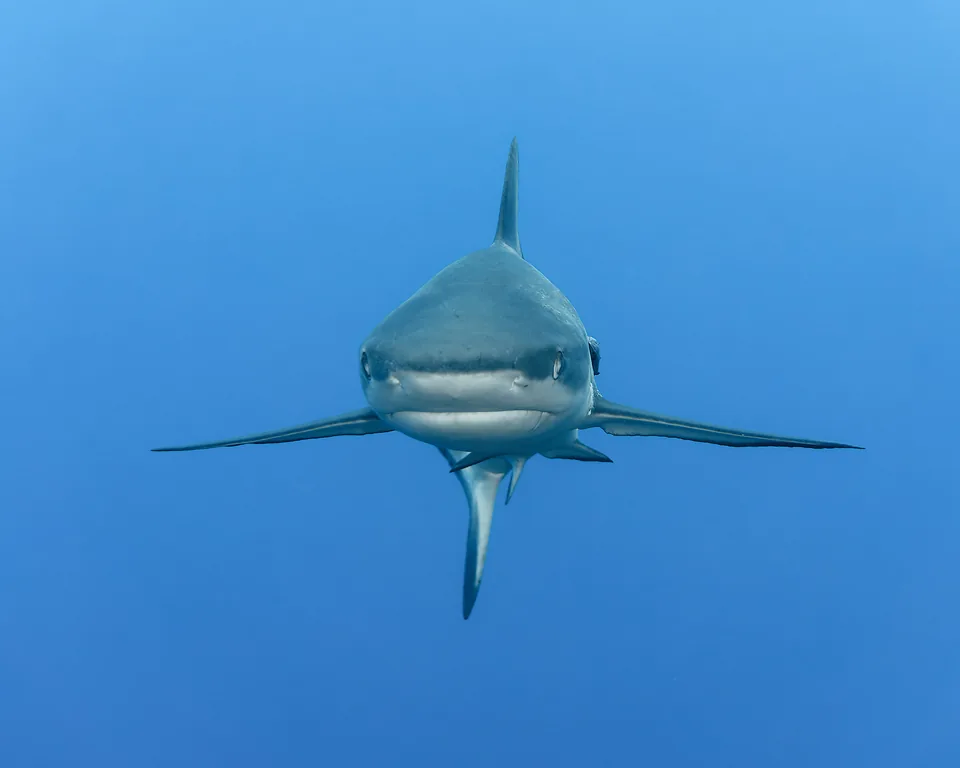
The south pass, Tumakohua, is what draws divers. Every year around the full moons of June and July, thousands of Camouflage Groupers gather there to spawn. In 2014, the marine biologists Johann Mourier and Antonin Guilbert made the first careful counts and arrived at about 17,000 groupers. They also found something they had not gone looking for: an extraordinary number of Grey Reef Sharks, with estimates ranging from about 250 to 700 animals, about three times the density the researchers had expected.
That raised an obvious question. In a healthy reef, the biomass of predators should be a small fraction of the biomass of their prey, yet in Fakarava’s south pass the sharks collectively weighed about as much as the fish around them. The researchers described it in Current Biology as an inverted food pyramid and concluded that the seasonal arrival of spawning groupers helps explain how the pass can support so many sharks. Fishing restrictions in place since 2006 also appear to have helped the shark population build up. It is a striking example of how closely the parts of a reef ecosystem depend on one another.
We found the aggregation just as promised, with groupers spread across the floor of the pass in numbers I had trouble taking in, and the famous wall of sharks hanging in the current above them. The full moon fell on June 11, between our last two days in the south pass, so we never saw the spawning itself. Knowing what the numbers mean made the scene even more remarkable in hindsight.
Tainui Ātea: protecting almost five million square kilometers
French Polynesia’s exclusive economic zone covers almost five million square kilometers of the South Pacific. In 2018 the territory declared the whole of it a managed marine area called Tainui Ātea. On June 9, 2025, the opening day of the UN Ocean Conference in Nice and the same week we were diving Fakarava, President Moetai Brotherson announced that Tainui Ātea would become a marine protected area. About 1.1 million square kilometers inside it were set aside for high or full protection. Roughly 900,000 square kilometers of that are fully protected: a 680,000-square-kilometer marine park around the Gambier Islands, which together with neighboring Pitcairn forms the largest strictly protected cross-border area in the world, and a 220,000-square-kilometer reserve near the Society Islands. The remaining 200,000 square kilometers are coastal zones open to small-scale, responsible fishing.
A year later, around World Oceans Day in June 2026, Brotherson announced about 520,000 square kilometers of new fully protected waters near the Austral, Marquesas, and Western Society Islands, where mining, trawling, and industrial fishing are not permitted. That brings about 1.4 million square kilometers, or roughly 30 percent of French Polynesia’s waters, under full protection. Counting the coastal fishing zones as well, the total under the highest protection categories reaches about 1.6 million square kilometers. The new Marquesas zone adds ocean protection on top of the World Heritage listing, and Conservation International’s announcement singled out the kūpūtea, the Marquesan Parrotfish I photographed at Nuku Hiva, as one of the endemic species it will help protect.
The scale is hard to grasp, and so is the problem of enforcing it. Brotherson himself has described surveillance of the area as insufficient; at the time of the 2026 announcement, France was patrolling it with a single multi-mission patrol vessel, with a second on the way. How well these commitments turn into lasting protection will depend on that enforcement, and on the communities in the islands who live closest to the water.
Two kinds of protection
The Marquesas and Fakarava show two different routes to the same goal. In the Marquesas, protection is arriving from the top down, through World Heritage listing and vast offshore reserves, for a marine wilderness that has so far been protected mainly by its remoteness. At Fakarava, it grew from the bottom up, through a biosphere reserve managed by the people of the atolls, and the result is a pass so full of groupers and sharks that scientists had to rethink how a reef food web can work. I’m grateful to have seen both while they are still in such good condition.
Sources
- Delrieu-Trottin, E. et al. (2015). Shore fishes of the Marquesas Islands, an updated checklist with new records and new percentage of endemic species. Check List 11(5): 1758.
- UNESCO World Heritage Committee (2024). Decision 46 COM 8B.8: Te Henua Enata – The Marquesas Islands.
- IUCN World Heritage Outlook (2025). Te Henua Enata – The Marquesas Islands.
- BirdLife International. Nord-ouest de Nuku Hiva Important Bird Area.
- MAB France. Commune of Fakarava Biosphere Reserve.
- National Geographic (2016). The world’s highest concentration of gray reef sharks.
- Ballesta, L. (2018). Shark Alley. National Geographic.
- IUCN (2025). Major breakthrough in marine conservation unveiled at UN Ocean Conference.
- Mongabay (2026). French Polynesia expands ocean protections to 30% of its waters.
- Pew Bertarelli Ocean Legacy (2026). French Polynesia strengthens world’s largest network of fully protected marine areas.
- Conservation International (2026). Conservation International celebrates French Polynesia’s leadership in global ocean protection.
- AFP, via Les Nouvelles Calédoniennes (2026). La Polynésie va renforcer la protection de la plus grande aire marine protégée du monde.