
Field report · French Polynesia · 31 May – 14 June 2025
Nuku Hiva and Fakarava
Sixteen dives in two very different corners of French Polynesia: the rocky, big-animal coast of Nuku Hiva in the Marquesas, and the passes of Fakarava as the groupers gathered to spawn.
Field account
After spending ten days aboard an Aggressor liveaboard in the Philippines on our previous adventure, my travel buddies and I decided it was time for something a little different, a notch down on the intensity scale. French Polynesia soon caught our attention, thanks in part to good reports from my dive buddies Dan and John, who had visited Manihi atoll in 2022. We had also learned about the annual grouper spawning at Fakarava, an extraordinary gathering that takes place around the full moons of June and July and, as luck would have it, coincided with our travel window.
Then there was Nuku Hiva. John Hoover had dived there many years earlier and recalled a high number of fish species found nowhere else in the world. That certainly caught my attention, and when I floated the idea with Terry and Rose, they were immediately on board. The plan came together: fifteen days exploring two very different corners of French Polynesia, beginning in the Marquesas at Nuku Hiva and finishing in the Tuamotus at Fakarava. As it turned out, the trip would prove to be challenging in ways I had not expected.
The expedition started testing us before we’d even made our first dive. Terry and Rose had planned to fly to Tahiti together, but a rather questionable airline “mistake” separated them along the way, leaving Rose to make the journey alone and arrive a day after Terry and me. Terry arrived in Papeʻete a few hours ahead of me, while there was still some daylight, and managed to find the airport lodge tucked away on the hillside. I arrived later, after dark, and wasn’t nearly so fortunate. I spent the better part of an hour wandering around the hillside, trying to locate the place, before finally giving up and heading back to the airport. There, I hailed a cab and paid $20 for what turned out to be a two-minute ride to the lodge. So much for the short walk I’d planned for.
And unlike a liveaboard, where you unpack once and let the boat carry you from one dive site to the next, this expedition meant moving ourselves and all our equipment between three islands. From Nuku Hiva, we flew back to Tahiti for an overnight stop before continuing on to Fakarava. Every transfer meant dragging the dive bags, camera cases, and everything else through another airport, onto another plane, paying the excess baggage ransom to the airline, and eventually hauling it all into another hotel.
Nuku Hiva’s underwater landscape reminded me of some of the more remote dive sites in Hawaiʻi: rocky bottoms dotted with scattered coral heads, moderate visibility, and often challenging surface conditions. The big animals, however, were something else entirely. Just two minutes into our very first dive at Cap Tikapo, on the southeastern tip of the island, a manta ray appeared, followed shortly by hammerhead sharks. It was quite an introduction to Nuku Hiva, and both creatures would make repeat appearances over the next couple of days. Unfortunately, Rose was still a day behind us and missed what turned out to be one of the best days of diving on the entire expedition.
We spent four days diving with Nuku Dive, returning to a site called Sentinelle each day. The seas became progressively rougher after our second day, adding another dimension to the experience, but Julie and her crew provided exceptional service from start to finish and shared our enthusiasm for every dive. I recommend them highly to anyone planning to dive the Marquesas. Part of the fun of diving with them was their genuine interest in, and knowledge of, the animals we were seeing. They spoke French and we spoke English, but that never got in the way of a good conversation about a species. One favorite was Thor amboinensis, a tiny shrimp they simply called ‘Thor.’ We’d come to know it as the Sexy Shrimp, named for the way it sways its raised tail.
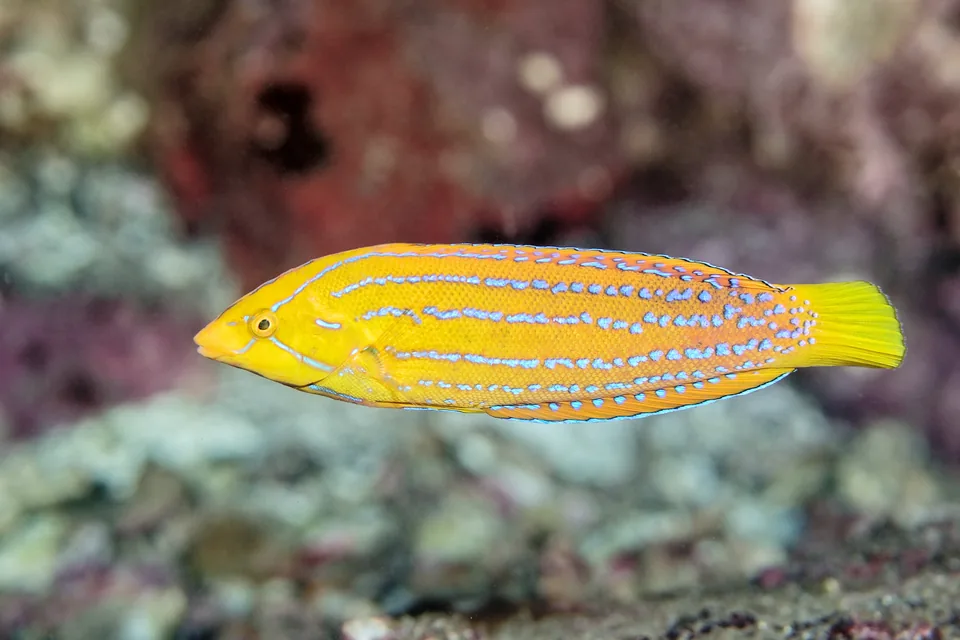
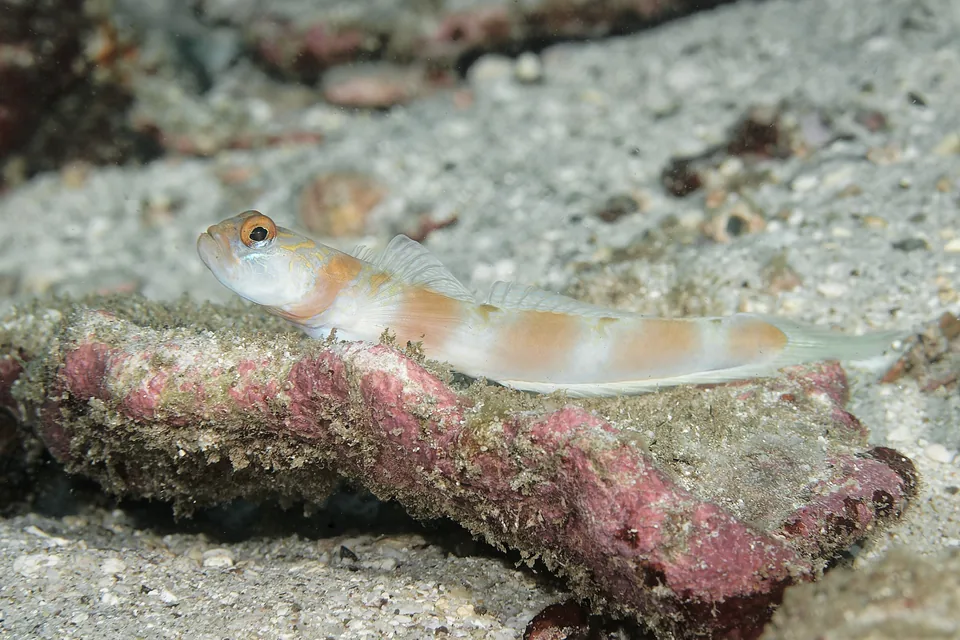
Finding the endemic species that had initially drawn me to the Marquesas proved more challenging than I’d anticipated. Still, there was plenty to discover, including several fishes and nudibranchs I had never seen before. A few short hikes on the slopes above town added some new bird species to the list as well. Two of the endemic fish I did manage to find are pictured below: the Marquesan Coris, a yellow wrasse marked with blue lines, and Amblyeleotris marquesas, an endemic shrimpgoby.
We spent time diving both of Fakarava’s passes, and quickly discovered that each had its own character. Our first day began with a boat ride to the South Pass that I still remember as one of the most punishing I’ve ever had. For a solid hour, we bounced around in the bow through a tropical downpour, perched on hard, unpadded seats while the front of the boat took the impact of every swell and wave. The captain, meanwhile, seemed blissfully unaware of our misery. Standing at the helm in the middle of the boat, he charged ahead at full throttle, singing along enthusiastically to Tahitian music blaring from the speakers. Apparently, he was having a considerably better morning than we were.
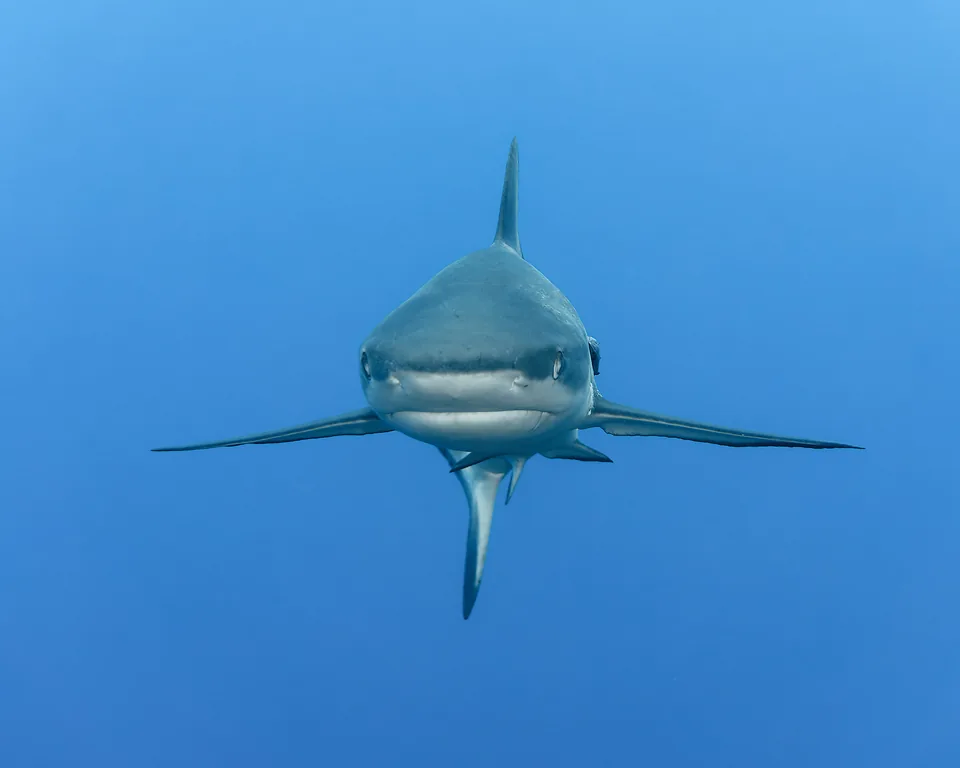
Fortunately, the diving more than made up for it. The South Pass is shallower, with manageable currents and excellent visibility. It’s also home to the famous wall of sharks, where hundreds of Grey Reef Sharks glide by in the current. The Grey Reef Shark in the photos below was one of them. I also had my first encounter with a Sicklefin Lemon Shark there.
The North Pass, which we explored the following day, was a different scenario altogether. It felt like the Wild West, with deeper water, ripping currents, and visibility that was decent but not as good as the South Pass had been. The payoff was another first for me: a Great Hammerhead. After that one day in the North Pass, we decided that was enough and spent our remaining Fakarava dives at the more accommodating South Pass.
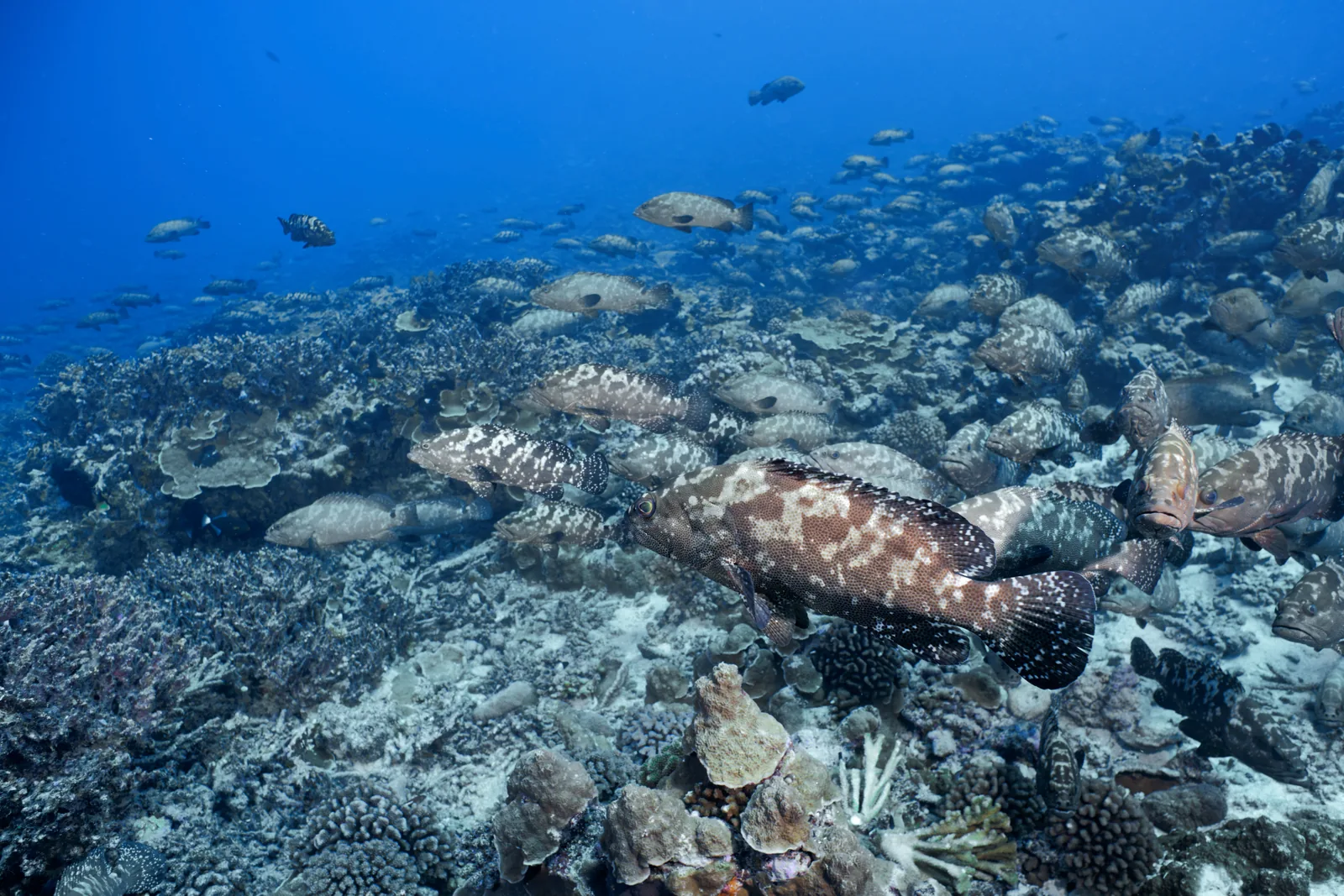
The groupers, meanwhile, were there just as promised. We found the aggregation, with Camouflage Groupers spread across the floor of the pass in numbers beyond my wildest imagination. Seeing so many gathered in one place was incredible, even if we never got to witness the actual spawning. The full moon fell on June 11, between our last two days diving the South Pass, and whatever transpired, it happened when we weren’t in the water.
Fourteen of my photographs from this trip went into John Hoover’s French Polynesia app, with credit listed on the Credits page. Between the endemic species of Nuku Hiva, the sharks of Fakarava, and the amazing grouper aggregation, the expedition gave us plenty to remember. Thank you, Terry and Rose, for another incredible trip.
Notable records
Endemic
Marquesan Coris Coris marquesensis
A wrasse known only from the Marquesas Islands, photographed at Nuku Hiva.
Endemic
Amblyeleotris marquesas Amblyeleotris marquesas
A shrimpgoby known only from the Marquesas Islands, photographed on sand at Nuku Hiva.
Endemic
Marquesan Parrotfish Scarus koputea
A parrotfish known only from the Marquesas Islands, photographed on several dives at Nuku Hiva.
Endemic
Marquesan Surgeonfish Acanthurus reversus
A close relative of the widespread Orangeband Surgeonfish, known only from the Marquesas and first described from Nuku Hiva.
Endemic
Strasburg's Dascyllus Dascyllus strasburgi
A damselfish known only from the Marquesas Islands, where it is common on coral and rocky reefs.
Endemic
Pakoko Wrasse Macropharyngodon pakoko
A leopard wrasse known only from the Marquesas Islands, described as a new species in 2014.
Endemic
Marquesas Dart Trachinotus macrospilus
A pompano known only from the Marquesas Islands, described as a new species in 2019.
Endemic
Northern Marquesan Reed Warbler Acrocephalus percernis
A songbird found only in the northern Marquesas, photographed near Taiohaʻe on Nuku Hiva.
Endemic
Polynesian Anemonefish Amphiprion maohiensis
Endemic to French Polynesia. Photographed at Fakarava a month before it was formally described as a new species in July 2025.
Behavior
Camouflage Grouper Epinephelus polyphekadion
The annual spawning aggregation in Fakarava's south pass, with large numbers of Grey Reef Sharks gathered around it.
Conservation context
Beyond the diving itself, both destinations are part of some remarkably important marine and terrestrial ecosystems. The Marquesas were added to the UNESCO World Heritage List in 2024 as Te Henua Enata, a mixed cultural and natural site recognized for its extraordinary biodiversity and cultural heritage. Their isolation has produced an unusually high degree of endemism: approximately 14% of coastal fish species and 10% of marine molluscs are found nowhere else. The surrounding waters also support exceptionally high fish biomass and large concentrations of apex predators, making the archipelago one of the Pacific's most remarkable marine wilderness areas. On land, however, endemic birds and plants face growing pressure from invasive species, introduced predators, and climate change.
Fakarava is part of a UNESCO Biosphere Reserve encompassing seven atolls in the Tuamotu Archipelago. Its south pass is particularly important for marine life, supporting one of the world's largest known spawning aggregations of Camouflage Grouper. More than 17,000 groupers gather there around the full moons of June and July, attracting an extraordinary concentration of grey reef sharks. Researchers have estimated that between 250 and 700 sharks gather in the pass. The relationship between the two species is especially interesting: the seasonal influx of spawning groupers provides a concentrated food source that helps sustain the unusually large resident shark population. It is a remarkable example of how closely connected the different parts of a marine ecosystem can be.
Since our visit in June 2025, French Polynesia has continued to expand its marine conservation efforts. At the United Nations Ocean Conference that month, President Moetai Brotherson announced plans to designate approximately 1.1 million square kilometres of highly or fully protected waters within Tainui Ātea, the managed marine area covering virtually the entire French Polynesian exclusive economic zone. A year later, the government announced a further expansion of about 520,000 square kilometres of new fully protected areas around the Marquesas, Austral, and Western Society Islands. That would bring roughly 1.4 million square kilometres, about 30 percent of French Polynesia's waters, under full protection, or about 1.6 million square kilometres when the coastal zones reserved for small-scale fishing are included. The expansion includes important habitats around islands and underwater seamounts, with an emphasis on protecting marine biodiversity while accommodating traditional fishing and local livelihoods. The scale of these commitments is impressive; how effectively they translate into lasting protection will be the real measure of their success.
Read the full story: French Polynesia: endemics, sharks, and a very large ocean →