
North Sulawesi's reefs and the people protecting them
My November 2024 trip to North Sulawesi took me to three places that sit within a short boat ride of one another: the walls of Bunaken off Manado, the reefs around Bangka Island, and the black-sand slopes of the Lembeh Strait. Underwater they share much of the same extraordinary Coral Triangle fauna. Above the water, each has had to answer a different question about how a reef gets protected and who pays for it. The expedition report has a short summary of each. This note is the longer version, with the sources I used.
Bunaken: a park that learned to pay its own way
Bunaken National Park was formally established in 1991, building on earlier provincial conservation efforts, and it covers about 89,000 hectares. The reef walls draw the divers, but the park also takes in mangrove forests, seagrass meadows, and habitat for dugongs and sea turtles.
For its first decade the park had a problem common to protected areas everywhere: it existed on paper, but there was little money to manage it, enforcement was weak, and many local people misunderstood or ignored the zoning. What changed things was a decision to bring everyone with a stake in the park into its management. A multi-stakeholder advisory board formed in 2000 brought government agencies, village representatives, and dive operators together, with support from USAID’s Natural Resources Management Program.
The board’s most important early move was an entrance-fee system, modeled on the one at Bonaire Marine Park in the Caribbean. Indonesian law normally sends user fees from national parks to the central government, so Bunaken needed a special waiver to run it as a pilot project. Under that arrangement, 80 percent of the revenue stays with the park’s advisory board and the remaining 20 percent is shared among local and central governments. The system raised nearly US$42,000 in its first year of operation in 2001, and the money went to work funding joint patrols that involve villagers alongside park staff and police.
It is easy to take a park fee for granted when you pay it at the dive shop. At Bunaken, it was the thing that turned a paper park into a managed one, and the arrangement is still cited as an example of how a marine park can fund itself.
Bangka: the island that went to court
Bangka sits off the northeastern tip of Sulawesi, and its reefs came close to a very different future. In 2008 the regent of North Minahasa granted PT Mikgro Metal Perdana, a subsidiary of a Hong Kong-based company, a permit to explore the island for iron ore. The concession eventually covered about 2,000 hectares, more than half of the island.
Residents and tourism operators feared what a large iron mine would do to the island’s mangroves, reefs, fisheries, and the dive tourism that was just getting established. In January 2012 they sued to have the permit revoked, citing Indonesia’s 2007 law governing small islands. They lost their first case in the administrative court in Manado that August but kept appealing, and in 2013 the Supreme Court annulled the exploration permit.
That should have been the end of it. Instead, in July 2014 the Ministry of Energy and Mineral Resources issued the company a production permit. The residents went back to court, and in July 2015 the State Administrative Court in Jakarta ruled entirely in their favor and ordered the permit revoked. The ministry and the company appealed, and in August 2016 the Supreme Court upheld the ruling. Even then the local government was slow to act, and the company kept operating on the island. The energy minister finally signed the revocation in March 2017. By that point the construction work had already damaged parts of the island, which is why the campaigners argued that revoking the permit should be followed by restoration and enforcement.
What strikes me about Bangka is how long it took, and how ordinary the people doing it were. Nine years passed between the first permit and its final revocation, and it was villagers and small dive-resort owners, with help from Indonesian environmental groups, who carried the case through every level of the courts.
Bangka faces a quieter threat that no court can settle. Between October and December 2018, two students supported by the No Trash Triangle Initiative surveyed litter at five sparsely populated sites along the Bangka Strait. They collected 9,421 items weighing 137 kilograms from just under 3,000 square meters, and found litter in every zone they examined, from the beaches down to the reef slope. Underwater, it collected in the reef flats and moats. In field experiments, plastic left in contact with the branching coral Porites cylindrica caused bleaching, tissue death, and algal overgrowth within five months. The beaches were far more polluted than the reefs, which makes waste collection on land the obvious place to start.
Lembeh: a busy port, a new protected area, and an invader
The Lembeh Strait runs between Lembeh Island and the port city of Bitung, a busy commercial port and tuna-fishing center. The muck slopes that make Lembeh famous among underwater photographers share the water with ships, coastal development, sediment, and pollution. This was my third visit, after trips in 2013 and 2019, and the contrast between the critters on the bottom and the traffic overhead never stops being strange.
In 2024 Indonesia’s Ministry of Marine Affairs and Fisheries designated a 9,659-hectare marine conservation area in Bitung’s waters, divided into three management zones. Its stated aims are to protect the coral reef ecosystem while keeping fishing and marine tourism sustainable. Whether that protection can hold up against the commercial activity around it is still an open question, but it gives the strait a legal framework it did not have before.
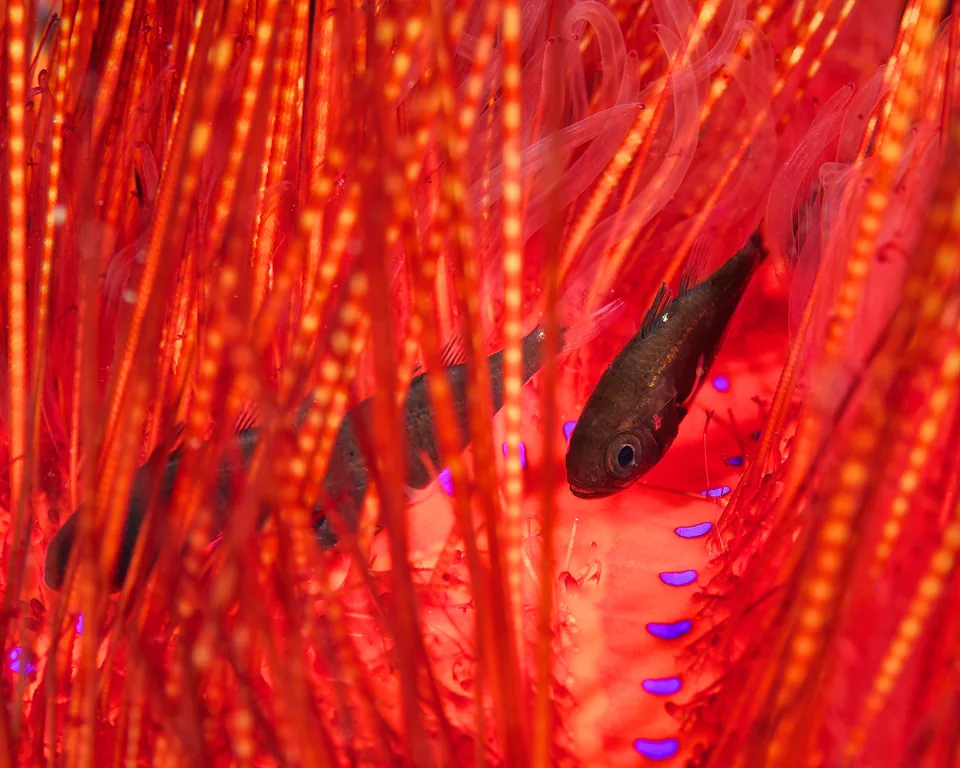
Lembeh also carries one of the stranger stories in Indonesian reef conservation. The Banggai cardinalfish, Pterapogon kauderni, is endemic to the Banggai Islands off central Sulawesi, several hundred kilometers to the south. Its striking pattern made it a favorite of the aquarium trade, and heavy collection pushed the wild population into decline; it is now listed as Endangered. In 2000, about fifty of them disappeared from an exporter’s holding pen in Lembeh Strait. Nobody knows whether they escaped or were released, but they settled among long-spined sea urchins in the shallows of a small island, and within a year there were more than 600. Their descendants have spread along the strait ever since.
With no natural predators to keep them in check, the Banggai cardinalfish now crowd the urchins and anemones that local species depend on, displacing anemonefish from their anemones and shrimpfish and native cardinalfish from the urchin spines they shelter among. I photographed Banggai cardinalfish on several dives during this trip, and it is hard to know how to feel about them. Endangered in their natural habitat, they have become an invasive species where they’ve been introduced. Similar introduced populations have since turned up in Kendari Bay in southeast Sulawesi and in the Bali Strait.
Three answers to the same question
Taken together, these three places show how differently a reef can end up protected. At Bunaken it took an institution and a steady source of money, while at Bangka it took residents willing to spend the better part of a decade in court. At Lembeh, formal protection has only just arrived, and it has to work alongside a port, a fishing fleet, and an invasive species that people brought there themselves. In each case the outcome still depends on the people who live and work along these coasts, and on whether the rest of us, divers included, keep paying attention.
Sources
- Erdmann, M. V. et al. The Bunaken National Marine Park Co-Management Initiative. USAID Natural Resources Management Program.
- Erdmann, M. V., Merrill, P. R. & Arsyad, I. (2003). Developing a decentralized user fee system for sustainable conservation financing of Bunaken National Marine Park.
- MPA News. Tools and strategies for financial sustainability.
- Mongabay (2016). Struggle against mining on Bangka Island continues despite wins in court.
- WALHI (2017). Withdrawal of PT MMP’s permit must be followed by recovery and enforcement on Bangka Island.
- UCA News (2017). Indonesian islanders win fight against mining firm.
- No Trash Triangle Initiative (2022). Investigation into North Sulawesi’s plastic pollution problem, summarizing Mueller, J. & Bill, N., A comprehensive approach to assess marine macro litter pollution and its impacts on corals in the Bangka Strait, North Sulawesi, Indonesia, Marine Pollution Bulletin.
- ANTARA, via Coral Triangle Center (2024). Ministry adds two conservation areas to boost blue economy.
- DAN Alert Diver. A Beautiful Invasion.
- Reef Builders (2011). Invasive Banggai cardinalfish.